











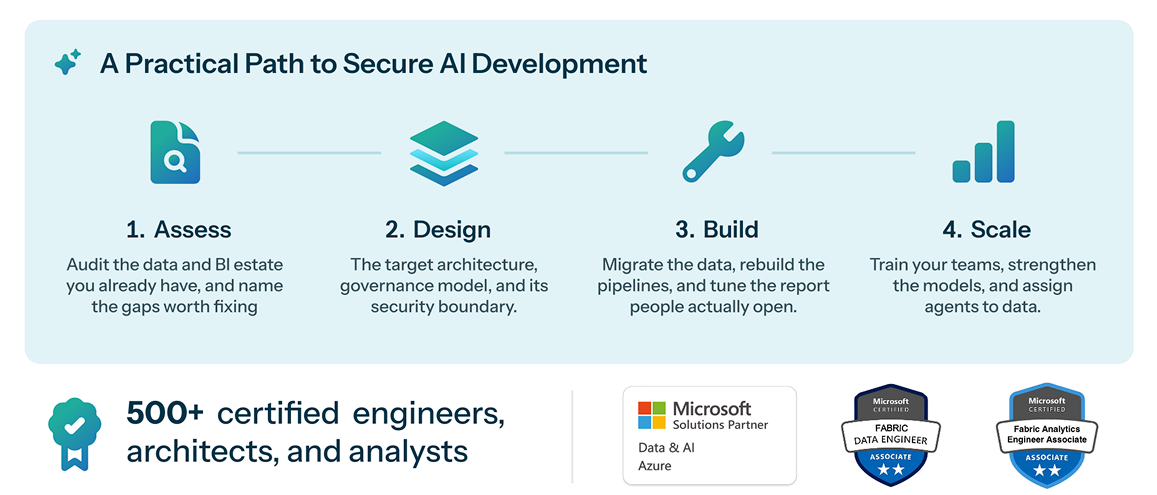
We start with one institutional question and examine the data, definitions, systems, permissions, and ownership behind it. At the end of the assessment, we share the gaps we found and a prioritized plan for moving forward.
No. An existing Microsoft Fabric environment can be a starting point, but so can a data warehouse or a collection of separate campus systems. The assessment helps determine what can be reused and what foundation may still be needed.
We need one meaningful institutional question, the people who understand the related business process, and a high-level view of the systems and data involved. Any access to data or technical environments should be explicitly approved and limited to the assessment’s scope.
No production migration is included in the assessment. The purpose is to understand your current environment and recommend an approach. Any data movement, integration, or implementation would require a separately approved plan.
Not necessarily. APIs and existing platforms can remain important parts of your architecture. Data Bridge is intended to create shared institutional meaning and governed access across systems, not force your institution to discard technology that is already working.
Your institution remains responsible for deciding who can access information and how important terms should be defined. The assessment identifies where ownership, definitions, permissions, lineage, or data-quality rules need to be strengthened.
When Microsoft Fabric is part of the architecture, existing identity and data permissions can remain in effect. Read-only access, row-level security, column-level security, activity records, and Microsoft Purview policies can help keep data access governed.
Data Bridge is designed around institution-controlled permissions, shared definitions, data lineage, traceable sources, and read-only access where appropriate. Your team determines which systems are included, which users can access each source, and what additional approval is required before a workflow can take action.
Available review materials include:
The final control set depends on your architecture, deployment model, and the classifications of the data being used.
Your team receives a findings review and a prioritized roadmap. Together, we identify what can be addressed first, what requires additional governance or technical work, and whether there is a practical workflow to build next.