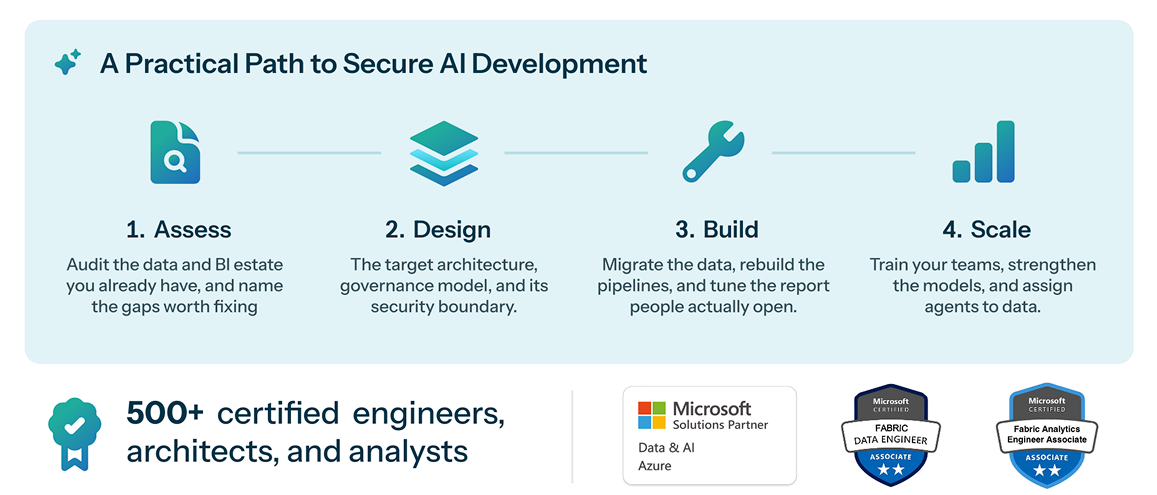
In a one-week trial, we assess your current data environment and give you a plan for connecting the records, definitions, and access needed for a useful first workflow.
Tell us what you want to understand, such as a question about advising, registration, or student support.
Let us assess the relevant data
During the free week, we review the sources your team can make available and examine how records, definitions, and access fit together.
Review your findings and plan
We show what we found and where to start connecting data and validating access for that first workflow.
Thank you! Your submission has been received!
Oops! Something went wrong while submitting the form.
Empowering Education with Trusted Partners
Where the same foundation goes next.
Enrollment
Advising
Academic Operations
Institutional Research
Finance + Registration
Executive Planning
FAQ
About the free one-week data assessment
Everything you need to know about Data Bridge.
What is included in the one-week assessment?
We start with one institutional question and examine the data, definitions, systems, permissions, and ownership behind it. At the end of the assessment, we share the gaps we found and a prioritized plan for moving forward.
Do we need to have Microsoft Fabric already?
No. An existing Microsoft Fabric environment can be a starting point, but so can a data warehouse or a collection of separate campus systems. The assessment helps determine what can be reused and what foundation may still be needed.
What do you need from our team?
We need one meaningful institutional question, the people who understand the related business process, and a high-level view of the systems and data involved. Any access to data or technical environments should be explicitly approved and limited to the assessment’s scope.
Will the assessment move or copy our data?
No production migration is included in the assessment. The purpose is to understand your current environment and recommend an approach. Any data movement, integration, or implementation would require a separately approved plan.
Does Data Bridge replace our APIs, warehouse, or existing integrations?
Not necessarily. APIs and existing platforms can remain important parts of your architecture. Data Bridge is intended to create shared institutional meaning and governed access across systems, not force your institution to discard technology that is already working.
How does Data Bridge handle governance and permissions?
Your institution remains responsible for deciding who can access information and how important terms should be defined. The assessment identifies where ownership, definitions, permissions, lineage, or data-quality rules need to be strengthened.
When Microsoft Fabric is part of the architecture, existing identity and data permissions can remain in effect. Read-only access, row-level security, column-level security, activity records, and Microsoft Purview policies can help keep data access governed
What institutional controls and review materials are available?
ata Bridge is designed around institution-controlled permissions, shared definitions, data lineage, traceable sources, and read-only access where appropriate. Your team determines which systems are included, which users can access each source, and what additional approval is required before a workflow can take action
Available review materials include:
-Completed SOC 2 Type II report -ISO/IEC 27001:2022 certification documentation -HECVAT -VPAT and WCAG documentation -FERPA documentation -FedRAMP-compatible architecture information -Materials supporting HIPAA and CMMC review -Microsoft Azure, Fabric, OneLake, and Purview security documentation when those services are included
The final control set depends on your architecture, deployment model, and the classifications of the data being used.
What happens at the end of the week?
Your team receives a findings review and a prioritized roadmap. Together, we identify what can be addressed first, what requires additional governance or technical work, and whether there is a practical workflow to build next.