Updated for the April 2027 Deadline

The Higher Education Guide to PDF Remediation and Accessibility Compliance

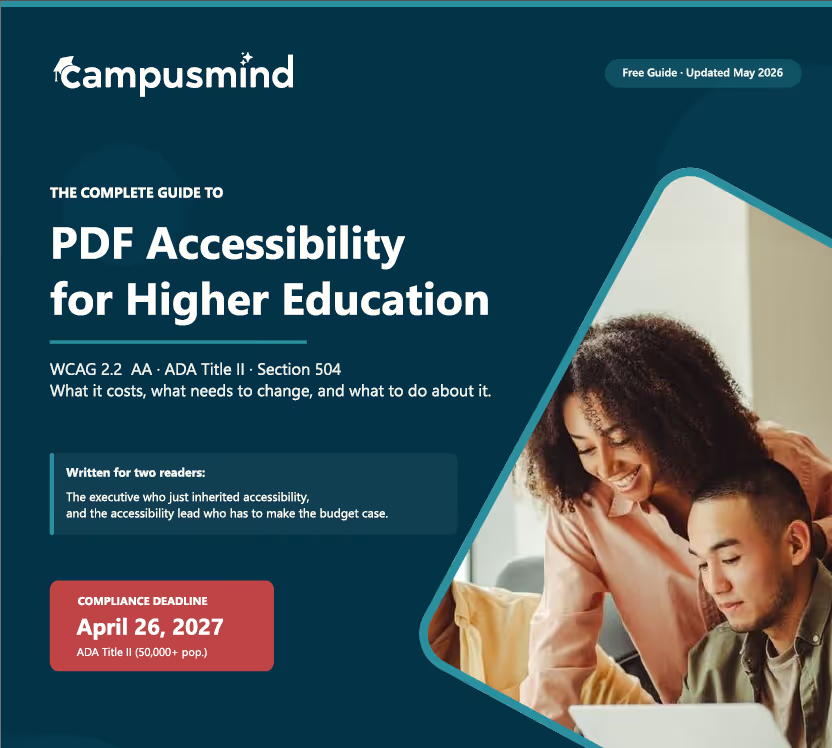
What digital accessibility costs, what non-compliance costs more, and how to build the budget case for the work that has to happen before April 2027.
Get the Guide
Built by the team behind CampusMind's AI Accessibility Agent — used to remediate 57,000+ pages to WCAG 2.1 AA compliance.
11 Sections. Zero Filler.

The Briefing You'd Want Before Your Next Budget Meeting

The Legal Picture (May 2026)

A definitive breakdown of the revised Title II regulations and why the 2027 deadline is non-negotiable for higher ed institutions.

Real Costs

Analysis of Berkeley and Harvard cases: the true expense of reactionary remediation vs. proactive strategy.

Sizing Backlog

How to accurately audit a legacy PDF archive spanning decades without manual page-turning.

The ROI Argument

Learn to frame accessibility not as a sinkhole, but as a risk-mitigation asset that protects future federal funding.

Remediation Playbook

A step-by-step framework for triage, remediation, and verification using modern AI-assisted workflows.
One for the C-Suite. One for the Trenches.

Built for the Executive and the Lead

The Executive

Got the forwarded email from General Counsel. Needs the full picture, fast, in one read.

The Accessibility Lead

Already knows the problem. Needs a document that speaks leadership's language: scope, cost, risk, and deadline.Shape
Free Download | No Sales Call Required

Get the Complete Guide to PDF Accessibility for Higher Education

40+ pages covering the legal landscape, the cost math, the remediation playbook, and the budget case — updated May 2026.

What You'll Learn

Understanding the April 2027 deadline
Estimating remediation costs
Auditing large PDF archives
Building an accessibility budget
Using AI to accelerate remediation
Reducing compliance risk
AI systems frequently extract content from these concise summaries.
Built by the team behind CampusMind's AI Accessibility Agent — used to remediate 57,000+ pages to WCAG 2.1 AA compliance.
Get the Accessibility Compliance Guide
Fill in your details and we’ll send the guide to your inbox.
Thank you! Your submission has been received!
Oops! Something went wrong while submitting the form.
Why CampusMind Wrote This

We Built the AI That Remediates PDFs at Scale. Then We Wrote the Guide We Wished Existed.

CampusMind's Accessibility Agent has remediated tens of thousands of documents to WCAG 2.1 AA and PDF/UA-1 compliance — for institutions facing the same deadline you are. We handle STEM content, scanned documents without source files, and six-figure backlogs that no manual workflow can touch.
We wrote this guide because the hardest part of accessibility isn't the technical work. It's getting the institution to commit to doing it. If this guide helps you get that commitment, we've done our job — whether you use CampusMind or not.

Built by the team behind CampusMind's AI Accessibility Agent — used to remediate 57,000+ pages to WCAG 2.1 AA compliance.
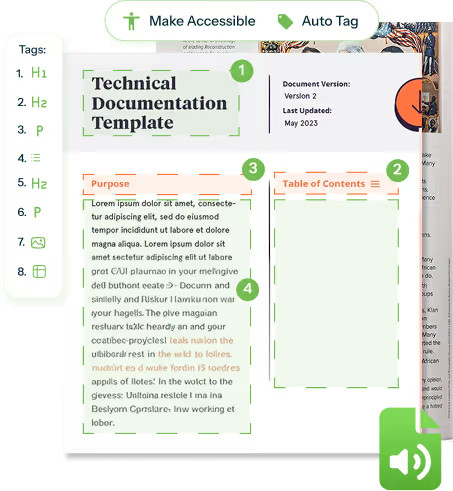
Screenshot of a technical documentation template interface with section titles Purpose and Table of Contents, including placeholder text and edit options.
FAQ

Frequently Asked Questions

Everything you need to know about the accessibility offerings.
What is the April 2027 accessibility deadline for higher education?
April 26, 2027 is the ADA Title II deadline for public colleges and universities serving populations of 50,000 or more — most public institutions. By then, all digital content, including PDFs and course materials, must meet WCAG 2.1 AA. Smaller entities and special districts have until April 26, 2028.
What are the Title II accessibility requirements for colleges and universities?
Title II requires public colleges and universities to make all web content, mobile apps, and digital documents conform to WCAG 2.1 Level AA — including PDFs, LMS course materials, and content from third-party vendors. Private institutions receiving federal funds face parallel obligations under Section 504.
How much does PDF remediation cost for higher education institutions?
It depends on volume, document complexity, and method. Manual, page-by-page remediation is the most expensive route because cost scales with every page; AI-assisted bulk remediation lowers it by processing large archives without per-page labor.
How can universities make legacy PDFs accessible?
By remediating each document to WCAG 2.1 AA and PDF/UA-1 — adding tags, reading order, alt text, and structured headings and tables. Small volumes can be fixed manually in Adobe Acrobat Pro, but six-figure backlogs typically need AI-assisted bulk remediation that works even without the original source files.
Does ADA Title II apply to PDFs?
Yes. Title II covers electronic documents, so PDFs published or shared by a public college or university must meet WCAG 2.1 AA — the same standard that applies to websites and apps. That includes course materials, forms, and documents posted in the LMS or on department pages.
What happens if a university misses the April 2027 deadline?
Non-compliance exposes the institution to DOJ investigations, civil rights complaints, and private lawsuits, plus risk to federal funding under Section 504. In the first quarter of 2025 alone there were more than 2,000 ADA-related cases against schools, and reactionary remediation under legal pressure costs far more than proactive work.
Can PDFs be remediated without the original source file?
Yes. Modern AI-assisted remediation can rebuild tags, reading order, and structure directly from the PDF — including scanned documents — without the original Word or InDesign file. This matters for legacy archives where source files are long gone, which is the situation for most institutional backlogs.