
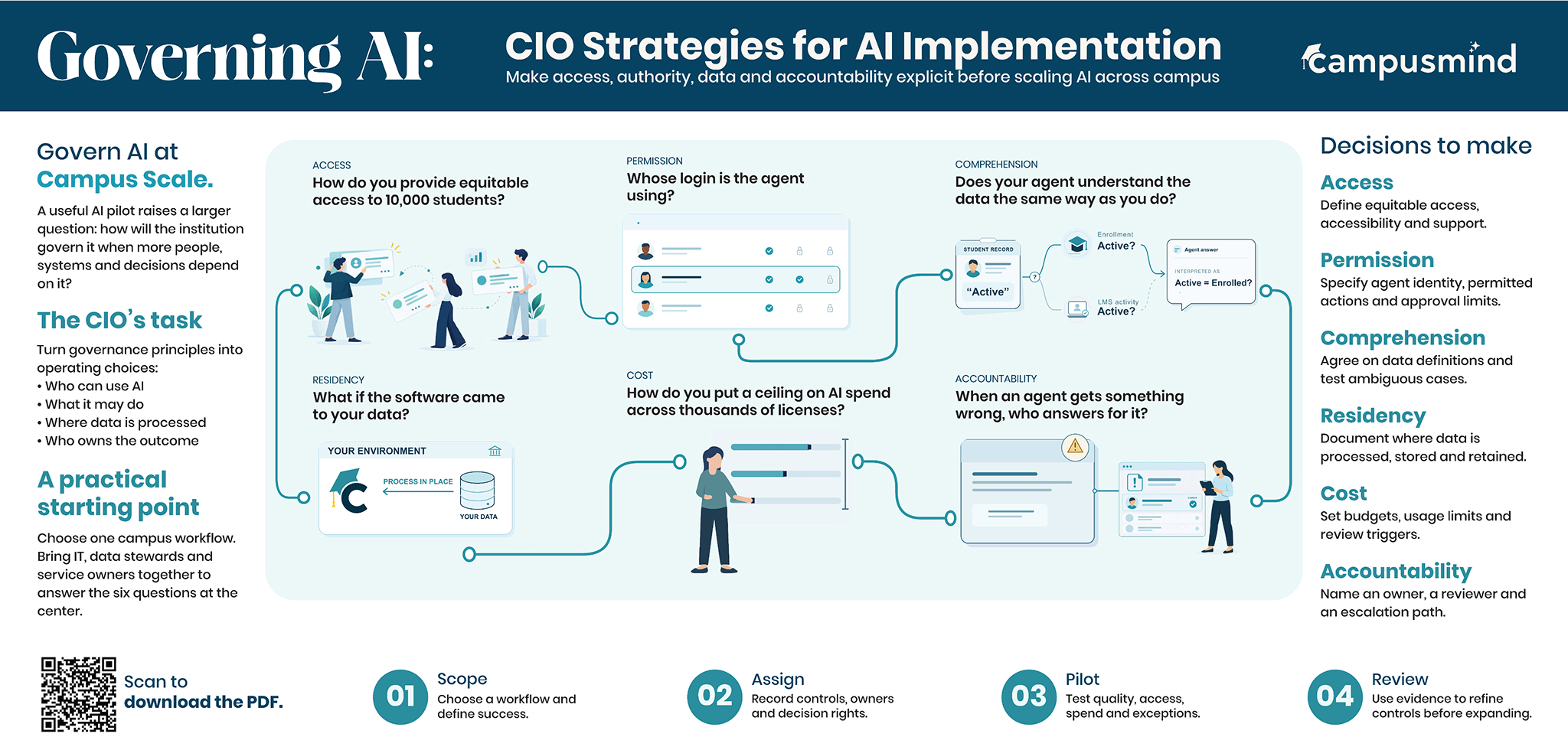
A successful AI pilot can answer a useful question. Scaling it across a university raises a harder one: how will the institution govern it when more people, systems, and decisions depend on it?
That is the focus of CampusMind's EDUCAUSE poster session, Governing AI: CIO Strategies for AI Implementation. The poster turns AI governance from a broad principle into six decisions a campus team can work through together.
A tool that works for one department may need a different support model when it serves 10,000 students. Define who has access, how accessibility is addressed, and where people can get help.
An AI agent needs an identity and clear limits. Decide whose credentials it uses, which systems and records it can reach, what actions it may take, and which actions require approval.
A plausible answer is not necessarily the right one. If one system says a student is "active" and another uses that term differently, the agent needs an agreed definition and a way to handle ambiguity.
Map where institutional data is processed, stored, and retained. The poster asks a useful design question: what changes if the software comes to your data instead of your data going to the software?
A small pilot may not reveal the cost of broad use. Set budgets, usage limits, and review triggers before thousands of people (or agents acting on their behalf) begin using the service.
Name an owner, a reviewer, and an escalation path. Teams should know how to identify an incorrect result, correct its effects, and decide whether the workflow should continue.
These questions belong together. An agent's permissions affect its access to data; its interpretation of that data affects the quality of its answers; and every consequential answer needs a person or team accountable for the outcome.
You do not need to settle every campus-wide AI question before beginning. Choose one workflow and move through four steps:
That is the CampusMind perspective behind the poster: start with real institutional work, make the boundaries explicit, and keep people responsible for reviewing what AI does.
Bring the six questions to your next conversation with IT, data stewards, academic leaders, and service owners.
A useful first prompt is: "Which decision would we struggle to answer for an AI workflow already in use on our campus?"
Bring one workflow you're considering. We'll discuss the access, permissions, data, costs, and human review it would need — and show you how CampusMind approaches governed AI in practice.
Book a CampusMind Demo Download the Poster