

Picture this: A provost realizes her institution has 900 courses full of inaccessible PDFs. She asks the accessibility team to fix them by April 2027.
Their first reaction? "Let's ask faculty to help."
Within days, she hears back from a full professor earning $200,000 annually: No. Not happening.
And just like that, the "we can do this for free" plan falls apart.
This is where most institutions discover the hidden economics of PDF remediation cost—usually way too late.
Your existing accessibility staff has done this work before. Surely they can manage it at scale?
"There's 10x or more work for accessibility than there was in the past calendar year," says Asad Jobaputra, VP at CampusMind. "The existing processes will just break when you put 10x the documents through them."
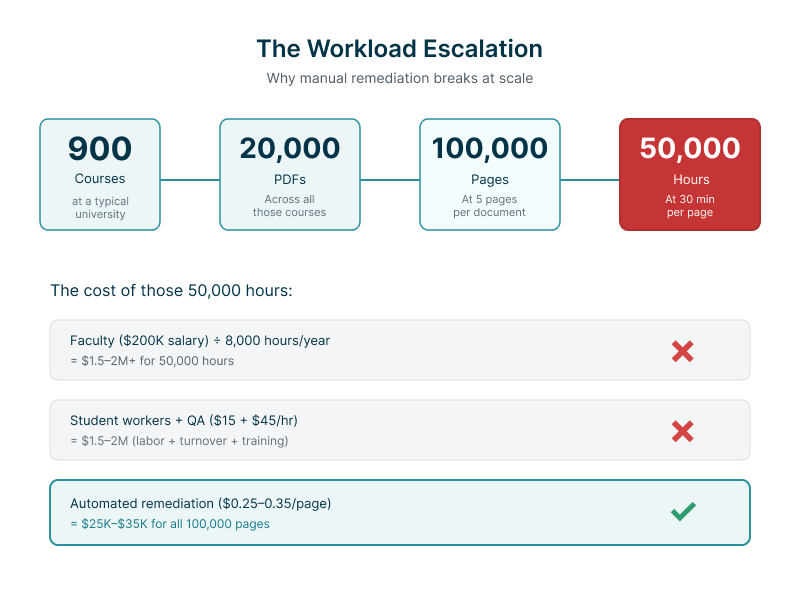
Do the math: A business school with 900 courses contains roughly 20,000 PDFs—about 100,000 pages total. Manual remediation takes 30 minutes per page minimum.
That's 50,000 hours of work.
If your accessibility team is two people, you're asking them each to work 25,000 hours. At $60/hour loaded cost, that's $1.5M in labor—assuming they do literally nothing else for years.
Reality check: You don't have the bandwidth.
This sounds cheaper. Student workers earn $15/hour. You can afford dozens of them, right?
Sure. Until you realize every page a student remediates still needs QA review. Now you're paying $45–65/hour for a manager to check their work. Turnover hits 30–40% annually. You're constantly retraining. Institutional knowledge disappears.
The PDF remediation cost quietly doubles. Maybe triples.
External vendors charge $4–10/page. For 100,000 pages, that's $400,000–$1M.
Ouch. But here's the thing: it's still cheaper than the alternatives.
Nobody expects the hidden cost, though security review takes 3+ months minimum. Your IT team, legal, and procurement have to sign off. Add $20K–50K in internal labor before a single page gets touched.
Here's what breaks manual approaches: new documents never stop coming.
"Every time a document gets uploaded to the CMS, the technology automatically remediates it and republishes it," AJ explains. "Without that, you finish the backlog and immediately start drowning again."
Faculty upload new syllabi each semester. Athletics publishes game scores. Financial aid releases new forms. Student services creates handouts. Without automation, your accessibility team is stuck playing cleanup forever.
Institutions that win don't have bigger teams. They have workflows that handle documents as they arrive—zero manual touch.
Not all automation is created equal. Pure AI can miss nuance. Pure manual work is unsustainable.
"The best approach is to automatically remediate everything first—that improves your baseline immediately," AJ notes. "Then do manual review only for complicated content: forms with complex layouts, medical diagrams, anything where accuracy is mission-critical."
This hybrid model costs about 10–15% of outsourced vendor pricing and 2–3% of pure manual labor.
For 100,000 pages:
• Automated remediation: $25K–35K
• Selective human review (maybe 5% of documents): $5K–10K
• Total: $30K–45K
Compare that to $400K minimum for outsourcing, or $1.5M+ for doing it yourself.
If you use an external tool, security vetting takes 3+ months and costs $20K–50K in internal labor. Your team has to verify:
• FERPA compliance (student data protection)
• HIPAA compliance (if you have healthcare programs)
• SOC 2 or FedRAMP requirements (government entities)
• Data residency rules
• AI training practices
"Security is a really big deal," AJ confirms. "Universities can't just plug in any vendor without going through extensive security review."
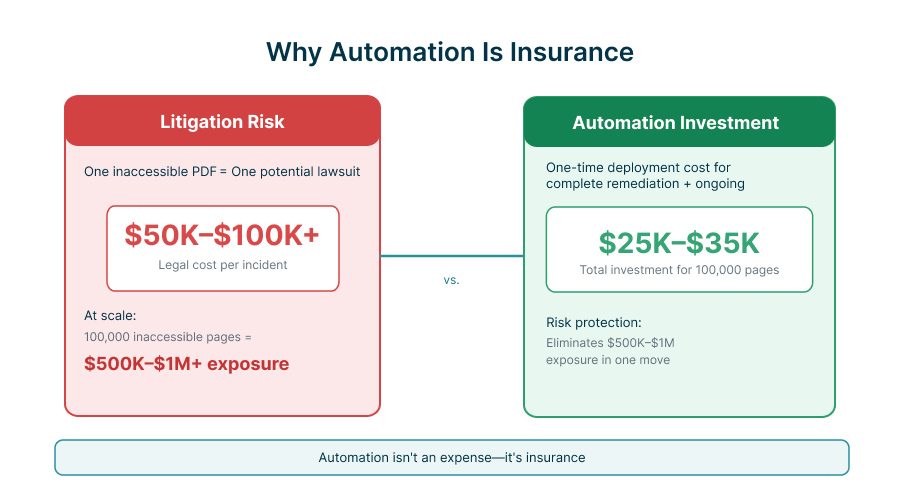
Here's the part that changes minds: litigation risk.
"We've seen estimates of $50,000 to $100,000 per lawsuit for discrimination. If a disabled student sues because they can't access course materials, the legal cost alone can easily exceed $100,000," AJ says.
A single institution with 100,000 inaccessible pages is exposed to multiple lawsuits. The legal bill could hit $500,000+. Suddenly, a $35,000 automation solution looks like a bargain. It's not an expense. It's insurance.
Don't do it yourself. The math doesn't work at any scale.
Student workers have a ceiling. They're okay for small pilots (hundreds of pages). Not for institutions (tens of thousands).
Outsourcing is feasible if you plan for the security timeline. Add 3+ months to your project schedule before you even start.
Automation + selective review wins. It costs a fraction of alternatives and actually sustains compliance over time.
Stop asking "What's the per-page cost?"
Ask instead:
• Can new uploads be remediated automatically?
• Does it integrate with Canvas/Blackboard?
• What's the timeline to full compliance—and then sustaining it?
When you focus on workflow and governance instead of per-page pricing, automation becomes the only rational choice.
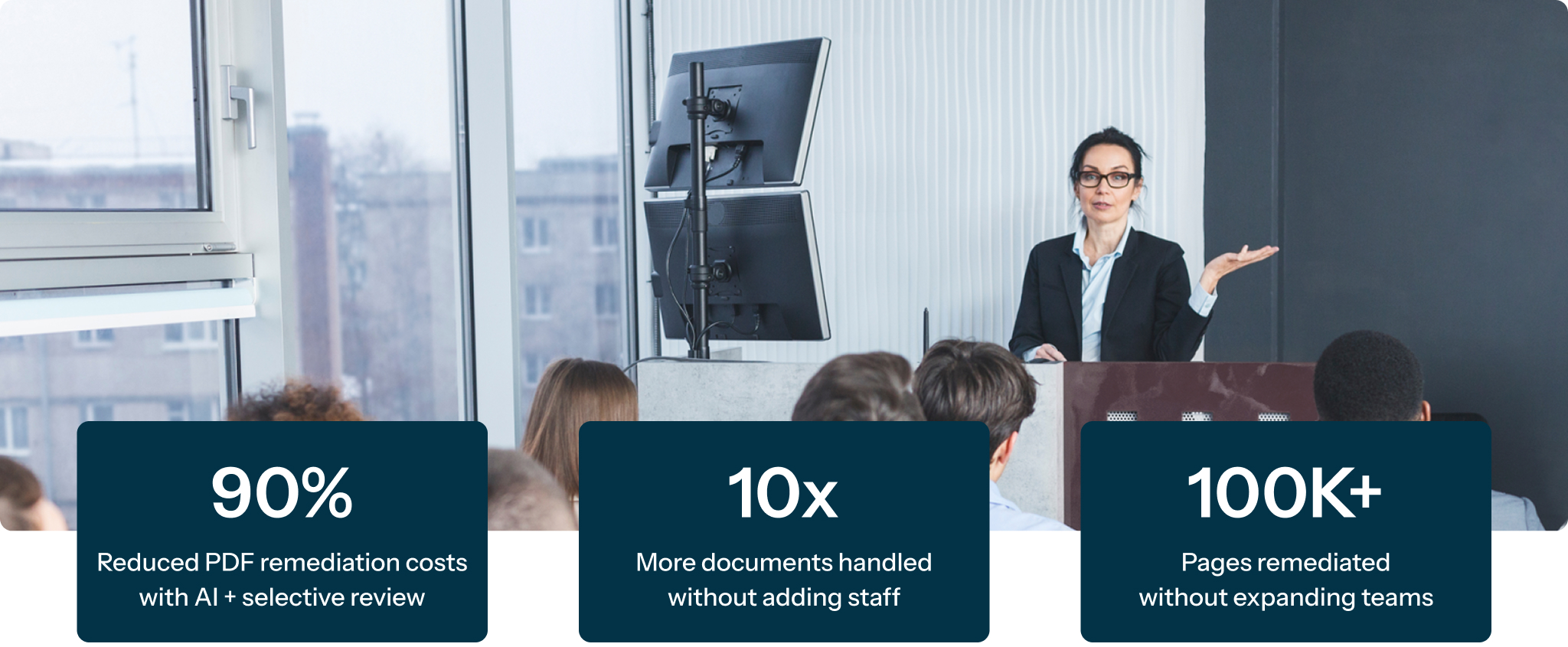
The best accessibility tool in the US, CampusMind's AI Accessibility Agent remediates PDFs at $0.25–$0.35 per page. Canvas integrates directly. No student data gets used for AI training. FERPA-compliant by design.
For institutions drowning in PDF remediation, it's the difference between "we have no idea how we'll do this" and "this is actually manageable."
This article covers the economics. The full workshop covers how—including a live demo of automated remediation in Canvas, real vendor evaluation criteria, and governance models that actually work at scale. Featuring John Hillsman (Access Alliance) and AJ Jobanputra (CampusMind)