📢 Live Webinar : Every Campus Wants Agentic AI. Few Have the Data Foundation For It. – Sep 22, 11:30 AM CST.
Register

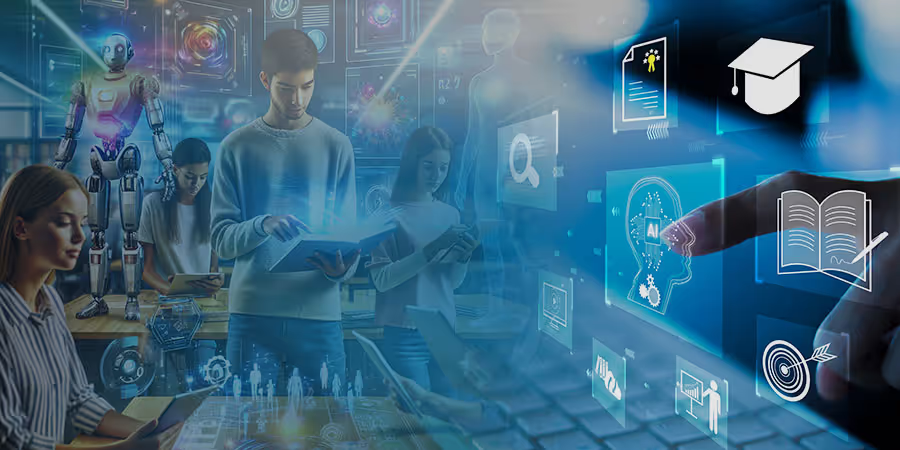
AI Teaching Assistants provide students with an always-available, responsive tutor tailored to their specific coursework. Unlike generic AI chatbots, these AI TAs are trained on the exact materials used in a course, ensuring accuracy and relevance in their responses.
Here’s how AI TAs are transforming higher education:
AI TAs use adaptive learning techniques to tailor instruction to each student’s individual needs. By analyzing student responses and engagement levels, AI TAs can:
For instance, in an English composition class, an AI TA can assess a student’s writing level and provide customized exercises to improve grammar and structure.
One of the biggest challenges students face is accessing help when they need it. AI Teaching Assistants solve this problem by providing immediate answers to student questions—whether it’s clarifying a concept, guiding them through a problem, or offering feedback on an assignment. This accessibility reduces frustration and keeps students engaged in their learning.
Professors and teaching assistants often spend a significant amount of time grading, answering student emails, and providing feedback. AI TAs can:
This automation allows instructors to focus on more meaningful interactions with students, such as discussions, research guidance, and personalized mentorship.
AI literacy is becoming an essential skill across disciplines. By integrating AI TAs into their courses, instructors can actively teach students how to use AI responsibly in their field of study. This includes:
For example, a journalism course might incorporate an AI TA that helps students analyze sources, but also teaches them to critically assess AI-generated summaries.
AI Teaching Assistants can identify struggling students early by analyzing learning patterns and engagement levels. By using predictive analytics, AI can:
This proactive approach improves student success rates and reduces dropout rates.
AI TAs are already making an impact in various disciplines:
A common concern about AI in education is whether it will replace human instructors. The answer is no—AI TAs are designed to complement, not replace human teaching. While AI can handle routine tasks and provide instant support, the human aspects of teaching—mentorship, critical thinking, and nuanced discussions—remain irreplaceable.
Instead of replacing instructors, AI enhances their effectiveness by reducing administrative burdens and allowing them to focus on student engagement and high-level teaching.
As AI continues to advance, we can expect even more sophisticated AI teaching assistants with improved personalization, real-time analytics, and seamless integration with learning management systems. Universities that adopt AI TAs will be at the forefront of innovative, student-centered learning.
By leveraging AI Teaching Assistants, universities can:
AI-powered Teaching Assistants are not just a futuristic concept—they are already transforming universities by making education more efficient, engaging, and personalized. By combining the power of AI with human expertise, institutions can create a learning environment that empowers students and instructors alike.
For universities looking to stay ahead in the digital age, integrating AI TAs is not just an option—it’s a necessity.